Quantum Benchmarking of High-Fidelity Noise-Biased Operations on a Detuned Kerr-cat Qubit
Abstract
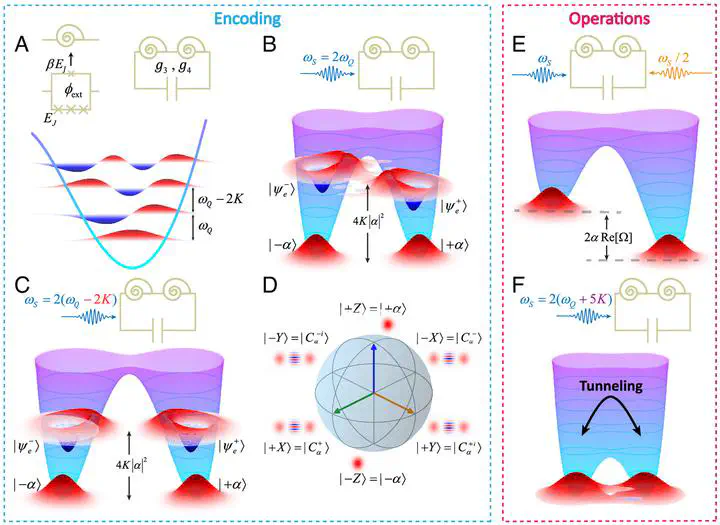
Ubiquitous noise sources in quantum systems remain a key obstacle to building quantum computers, necessitating the use of quantum error correction codes. Recently, error-correcting codes tailored for noise-biased systems have been shown to offer high fault-tolerance thresholds and reduced hardware overhead, positioning noise-biased qubits as promising candidates for building universal quantum computers. However, quantum operations on these platforms remain challenging, and their noise structures have not yet been rigorously benchmarked to the same extent as those of conventional quantum hardware. In this work, we develop a comprehensive quantum control toolbox for a scalable noise-biased qubit, detuned Kerr-cat qubit, including initialization, universal single-qubit gates, and quantum nondemolition readout. We systematically characterize the noise structure of these operations using gate set tomography and dihedral randomized benchmarking, achieving high local gate fidelities, with F[Z(pi/2)] = (99.18 \pm 0.066)% and F[X(pi/2)] = (92.5 \pm 0.23)%. Notably, the noise bias of the detuned Kerr-cat qubit approaches 250 with a phase-flip time of 4μs, which outperforms its resonant-Kerr-cat qubit counterparts as reported previously, representing a state-of-the-art performance benchmark for Kerr-cat qubits. Moreover, our results reveal a critical overestimation of operational noise bias inferred from bit-flip and phase-flip times alone, highlighting the necessity of a precise and direct benchmarking for noise-biased qubit operations. Our work thus establishes a framework for systematically characterizing and validating the performance of quantum operations in structured-noise architectures, which lays the groundwork for implementing efficient quantum error correction in next-generation architectures.
Justin Dressel
Associate Professor of Physics
Researches quantum information, computation, and foundations.