Abstract
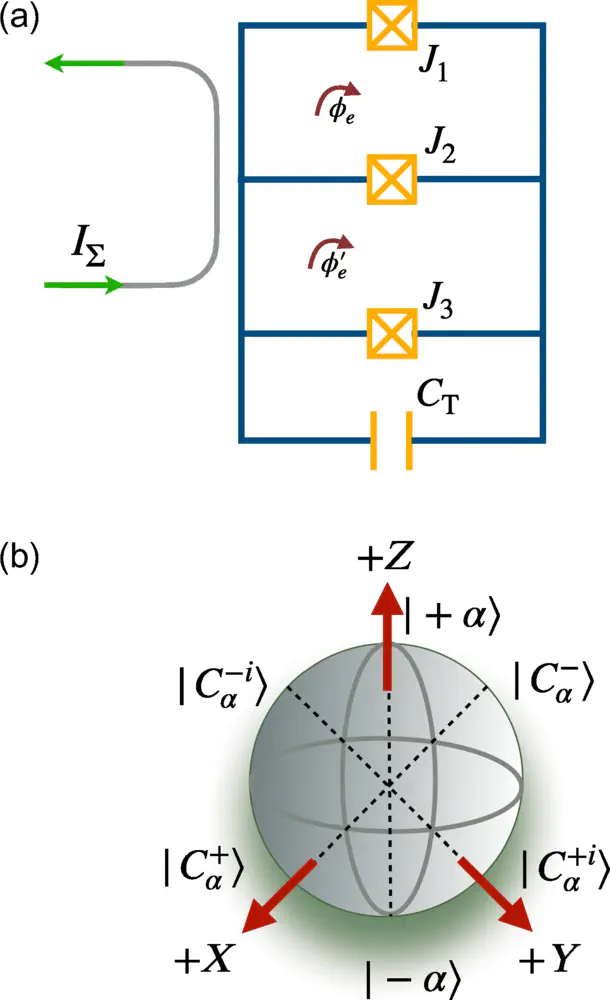
Kerr-cat qubits are bosonic qubits offering autonomous bit-flip protection, traditionally studied using driven superconducting nonlinear asymmetric inductive element (SNAIL) oscillators. Here, we theoretically explore an alternative circuit for Kerr-cat qubits based on symmetrically threaded superconducting quantum interference devices (SQUIDs). The symmetrically threaded SQUID (STS) architecture employs a simplified flux-pumped design that suppresses two-photon dissipation, a dominant loss mechanism in high-Kerr regimes, by engineering the drive Hamiltonian’s flux operator to generate only even-order harmonics. By fulfilling two critical criteria for practical Kerr-cat qubit operation, the STS emerges as an ideal platform: (1) a static Hamiltonian with diluted Kerr nonlinearity (achieved via the STS’s middle branch) and (2) a drive Hamiltonian restricted to even harmonics, which ensures robust two-photon driving with reduced dissipation. For weak Kerr nonlinearity, we find that the coherent state lifetime (𝑇𝛼) is similar between STS and SNAIL circuits. However, STS Kerr-cat qubits exhibit enhanced resistance to higher-order photon dissipation, enabling significantly extended 𝑇𝛼 even with stronger Kerr nonlinearities (approximately 10 MHz). In contrast to SNAIL, STS Kerr-cat qubits display a 𝑇𝛼 dip under weak two-photon driving for a high Kerr coefficient. We demonstrate that this dip can be suppressed by applying drive-dependent detuning, enabling Kerr-cat qubit operation with only eight Josephson junctions (of energies 80 GHz); fewer junctions suffice for higher junction energies. We further validate the robustness of the STS design by studying the impact of strong flux driving and asymmetric Josephson junctions on 𝑇𝛼. With the proposed design and considering a cat size of ten photons, we predict 𝑇𝛼 of the order of tens of milliseconds, even in the presence of multiphoton heating and dephasing effects. The robustness of the STS Kerr-cat qubit makes it a promising component for fault-tolerant quantum processors.
Justin Dressel
Associate Professor of Physics
Researches quantum information, computation, and foundations.